A boat can look freshly washed at the dock, then dry into a map of white spots across the gelcoat, glass, rails, and eisenglass. That is the practical difference behind the water softener versus descaler question. Both are marketed as hard-water solutions, but they do not do the same job – and choosing the wrong one can leave you doing the same cleanup all over again.
For owners who wash boats, RVs, vehicles, or aircraft with hard water, the key question is simple: Do you need to remove minerals from the water, or are you only trying to reduce scale inside a fixed plumbing system? The answer determines whether a softener or a descaler is the better fit.
Water Softener Versus Descaler: The Core Difference
Hard water contains dissolved calcium and magnesium. Those minerals are harmless in many situations, but they are responsible for the deposits and cleaning headaches owners see every day. When hard water evaporates, minerals remain on the surface. When it is heated or sits inside plumbing, those same minerals can form scale.
A water softener removes calcium and magnesium through ion exchange. Water passes through resin beads that trade the hardness minerals for sodium ions. The result is genuinely soft water: water that rinses cleaner, leaves far fewer spots, allows soap to work better, and helps prevent mineral scale.
A descaler, often called a salt-free conditioner, generally does not remove calcium or magnesium from the water. Depending on its design, it may attempt to change how minerals behave, such as encouraging them to form crystals that are less likely to stick to plumbing surfaces. Electronic and magnetic devices make similar claims through a different approach. The minerals remain in the water.
That distinction matters. If your goal is spot-free washdowns and reduced mineral residue on expensive exterior finishes, removing the minerals is the direct solution. If your goal is strictly to manage scale in the plumbing of a stationary building, a descaler may be worth considering, depending on water conditions and expectations.
Why Descalers Fall Short for Washdowns
A descaler may help reduce certain forms of scale under the right conditions, but it does not turn hard water into soft water. You may still see water spots after washing a boat. You may still have mineral residue on glass, polished metal, painted surfaces, and dark-colored finishes. Soap can still perform poorly because the calcium and magnesium are still present.
This is where marketing language can cause confusion. “Scale prevention” is not the same as “mineral removal.” A device can be useful for a household water heater or fixed plumbing line while doing little to improve the finish of a freshly washed yacht.
For marine and mobile applications, the visible results matter. A boat owner is not only concerned about what happens inside a pipe. They are protecting gelcoat, stainless steel, clear vinyl, windows, shower fixtures, tanks, and onboard appliances. The same applies to RV owners protecting exterior paint and plumbing, or vehicle and aircraft owners trying to avoid spotting after every rinse.
A descaler also needs to be evaluated carefully when the system is portable. Many conditioning technologies are designed for permanent installation, require a power source, or depend on specific flow rates and water chemistry. That is not always practical at a marina, campground, storage facility, or remote wash location.
What a Portable Water Softener Does Better
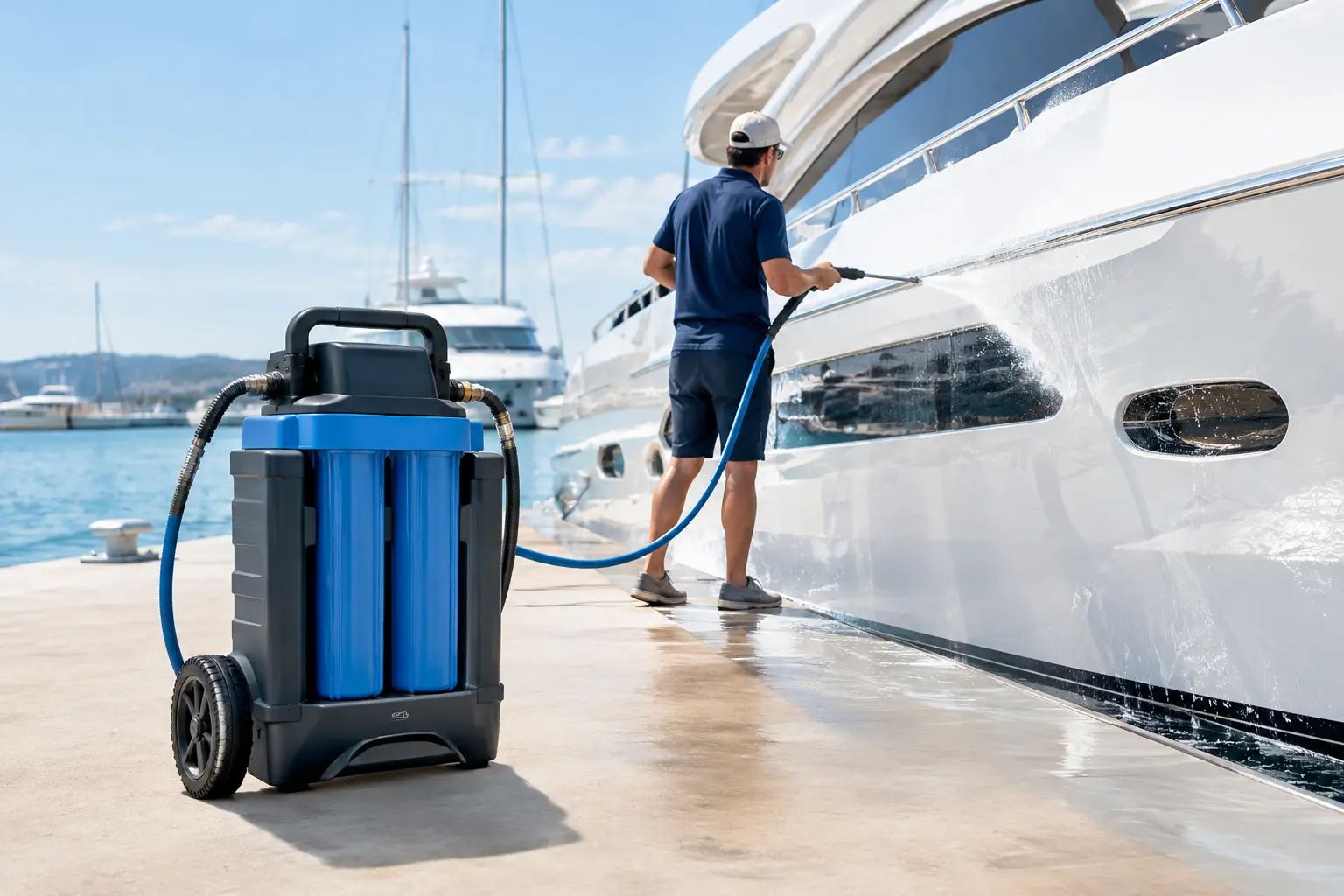
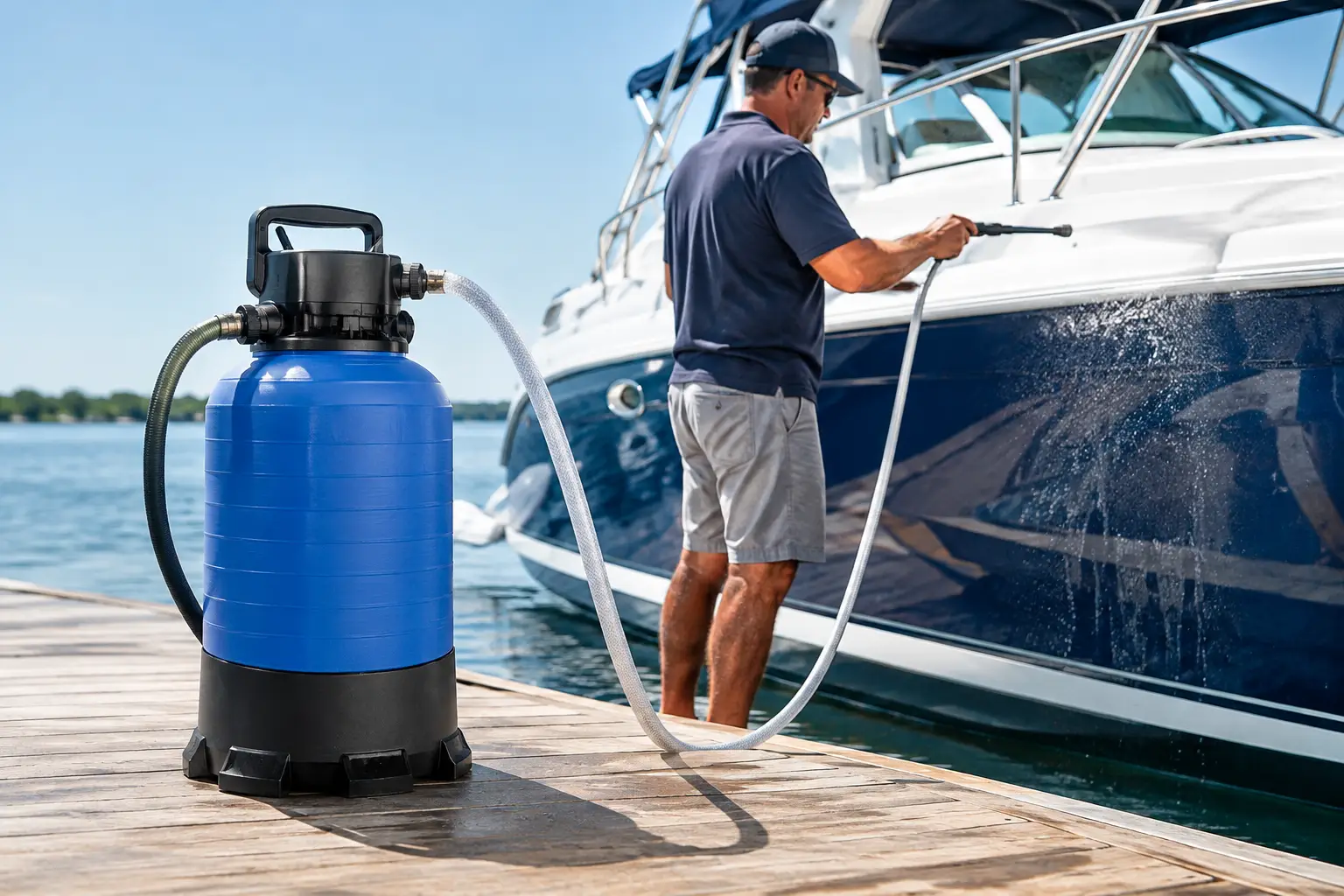
A portable water softener is built for the real work of washing and rinsing valuable equipment away from home. It connects between the water source and hose, treating the water before it reaches the boat, RV, vehicle, or aircraft.
Because the hardness minerals are removed, soft water helps reduce the white spotting that appears as rinse water dries. It also improves soap and detergent performance, so wash products can do their job without fighting calcium and magnesium. Less mineral residue means less time chasing spots with towels, detail sprays, or repeated rinsing.
The benefit goes beyond appearance. Scale can accumulate on faucets, showerheads, hoses, valves, water heaters, and appliances. Soft water helps reduce that buildup before it becomes a maintenance problem. For vessels with onboard systems, this can mean less cleanup and better protection for components that are expensive or inconvenient to replace.
Portable softeners are particularly useful because hard-water exposure is not limited to one location. A boat may visit different marinas. An RV may travel through several states. A vehicle or aircraft may be washed wherever water is available. A fixed softener cannot follow the asset, but a portable unit can.
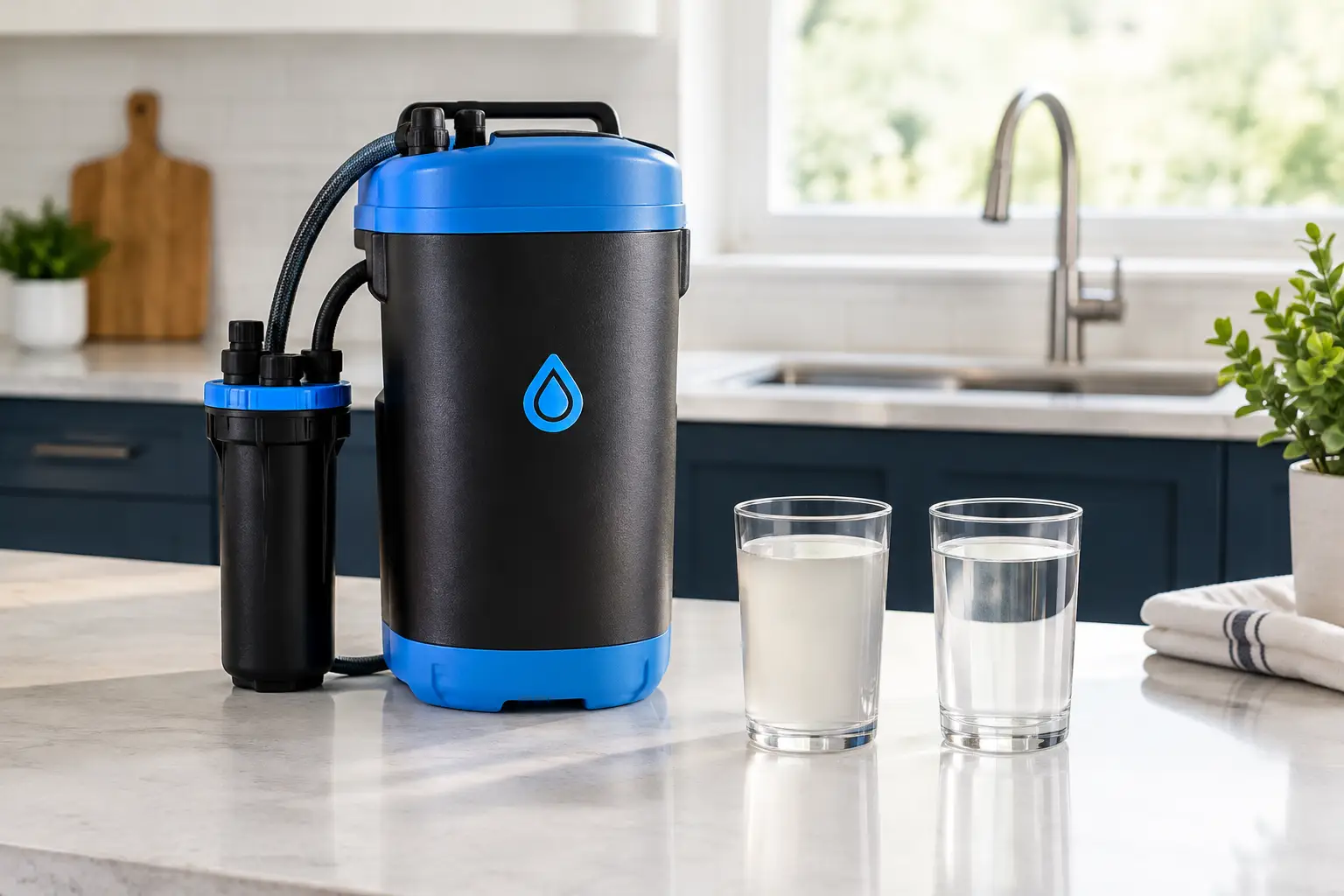
Wet Spot portable soft water systems are designed for that purpose: no electrical hookup, straightforward hose connections, manual recharge, and rugged construction for demanding mobile use. The goal is not to add another complicated piece of equipment to a washdown routine. It is to provide soft water where it is needed.
The Trade-Offs to Consider
A water softener is not maintenance-free. Once the resin has collected its capacity of hardness minerals, it must be recharged with salt. How often depends on the hardness of the incoming water and the amount of water used. A larger vessel, frequent washdowns, or extremely hard water will require more attention than occasional use with moderately hard water.
That maintenance is a fair trade for owners who need actual soft water. Recharging restores the resin so the system can continue removing calcium and magnesium. It is a predictable, hands-on process rather than a mystery performance claim.
Descalers have their own advantages. They typically do not need salt, and some are intended to operate with little routine maintenance. For a home with fixed plumbing, an owner who mainly wants to address potential scale in pipes may prefer that approach. They can also avoid adding sodium through ion exchange, which may matter for certain household water uses.
But a descaler should not be chosen because it is expected to produce spot-free rinse water. It does not remove the dissolved minerals that leave deposits behind. If the problem you see is white spotting on a hull, windshield, shower door, chrome fixture, or painted surface, a true softener is the more appropriate tool.
Which System Fits Your Application?
For boat owners, a water softener is usually the better answer when washdown quality and finish protection are the priorities. Soft water helps preserve the clean appearance of gelcoat, metal, glass, plastic, and eisenglass while reducing the labor that follows a hard-water rinse. It also helps protect onboard plumbing and appliances from mineral buildup.
For RV owners, the same logic applies. Soft water can make exterior washing easier and reduce scale at sinks, showers, and water connections. The portability is valuable because campground water quality changes from stop to stop.
For automotive and aviation use, mineral-free rinse results are often the deciding factor. Hard-water spots can be especially noticeable on dark paint, polished metal, glass, and clear surfaces. A softener supports a cleaner final rinse and reduces the need to correct water marks after the fact.
A descaler may make sense for a stationary property where a permanent system is the goal and visible spotting is not the main concern. It may also be considered where salt handling is not practical. Just be clear about the outcome: it is a conditioning approach, not a source of soft water.
Ask This Before You Buy
Before choosing a system, start with the problem you actually want to solve. If you are tired of wiping down spots after every wash, seeing crust around fixtures, replacing scale-affected parts, or using extra soap with disappointing results, you are dealing with the effects of minerals in the water. Removing those minerals is the most direct response.
Also consider where you use water. A portable unit is a better match for boats, RVs, and other assets that move between locations. Look for durable construction, a capacity that matches the size of your vessel or equipment, simple connections, and a recharge process you can handle without specialized service.
Hard water does not have to become part of your maintenance routine. Use a descaler when fixed-plumbing scale management is the objective. Use a portable water softener when the job calls for cleaner rinses, fewer spots, and practical protection for the equipment you worked hard to own.